


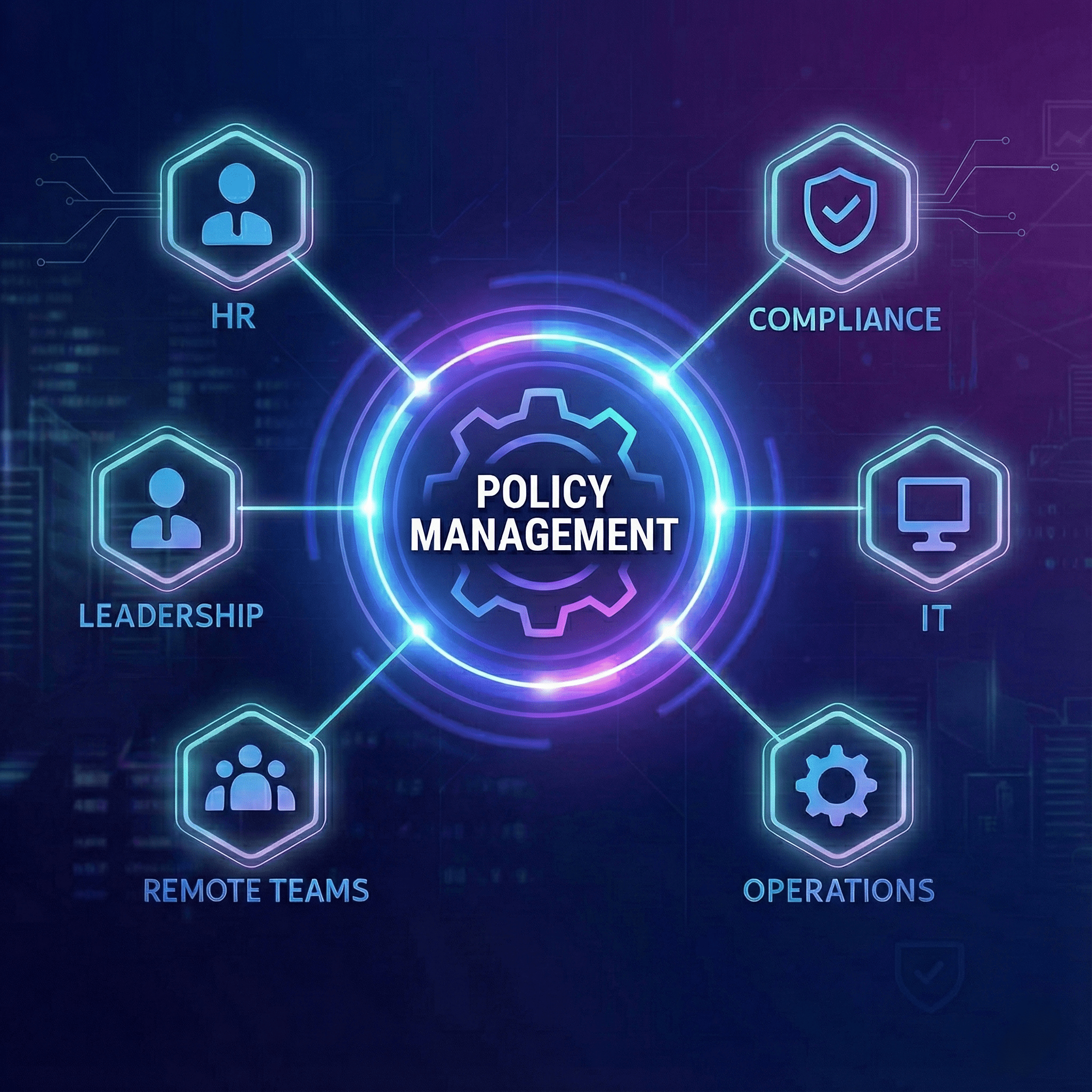
When people ask, “Why is policy management important?” they often expect an answer about compliance requirements or documentation rules. And while those are factors, they only scratch the surface.
Behind every successful organization—whether a hospital, school district, government agency, or large enterprise—there is an invisible system guiding behavior, decisions, and accountability. That system is policy management.
Policies are not documents. They are the decision infrastructure of an organization. They determine how employees act under pressure, how leaders respond to risk, and how consistently teams operate when no one is watching. Without effective policy management, organizations don’t just face compliance failures—they face uncertainty, inconsistency, and cultural instability.
This article explores why policy management is important not just as a regulatory function, but as a foundation of organizational clarity and resilience.
Why Policy Management Is Important: The Strategic View
Most organizations experience problems long before they realize policy management is the missing link. The symptoms look like operational, HR, or cultural issues—but the root cause is unclear or outdated rules.
Here’s why policy management is important far beyond compliance obligations:
1. Policies Create Decision Clarity During High-Stakes Moments
The most important decisions in an organization rarely happen under calm conditions.
They happen:
- During a patient emergency
- During a cybersecurity alert
- During a complaint investigation
- During a natural disaster or crisis communication event
Strong policy management ensures that people don’t improvise under pressure—they respond appropriately because expectations are documented, accessible, and unambiguous.
This is why policy management is important: it prevents costly improvisation when precision matters most.
2. Policies Preserve Organizational Memory
People leave. Roles change. Leaders retire. But the knowledge that keeps an organization stable must remain.
Policies act as an organization’s memory, preserving:
- Critical procedures
- Safety requirements
- Ethical expectations
- Institutional standards
Without structured policy management, knowledge becomes tribal—held by a few people instead of the organization as a whole. When those people leave, inconsistency spikes and risk follows.
This long-term preservation is a major reason policy management is important for sustainability.
3. Policies Reduce Ambiguity and Unfairness
Ambiguity is expensive. It leads to:
- Disputes
- Misinterpretations
- Perceived favoritism
- Unequal treatment
Clear, well-managed policies eliminate guesswork and promote fairness.
If two employees receive different answers to the same question—such as leave eligibility, safety procedures, or disciplinary actions—you don’t have a people problem. You have a policy management problem.
This is why policy management is important: it protects organizational integrity by ensuring decisions are grounded in consistent standards.
4. Policies Strengthen Organizational Culture
Culture is built on repeated behaviors, and repeated behaviors are guided by policies.
When policies are missing, outdated, or scattered:
- Culture becomes inconsistent
- Managers interpret rules differently
- Employees feel disconnected from expectations
- Remote or distributed teams lose alignment
Modern policy management reinforces culture by ensuring the rules people live by reflect the organization’s values today—not five years ago.
5. Policies Demonstrate Accountability and Build Trust
Regulators, auditors, employees, and customers all expect organizations to show evidence of sound governance.
Effective policy management helps organizations demonstrate:
- Transparency
- Consistency
- Ethical safeguards
- Preventative risk controls
- Documented accountability
Trust is not built through claims; it’s built through documented proof. And that proof comes from strong policy governance.
This is a critical reason why policy management is important for credibility and public confidence.
What Happens When Policy Management Fails?
When policy management breaks down, organizations often don’t notice the impact right away. The real damage shows up later in the form of preventable errors, inconsistent decisions, and costly compliance failures.
Scenario 1: The Wrong Protocol During an Incident
A staff member follows an outdated emergency procedure stored in their email instead of the current one. A preventable injury occurs.
Root cause: unmanaged policy updates, not employee negligence.
Scenario 2: Distributed Teams Act Inconsistently
Half the workforce uses old forms found on shared drives; the other half uses new ones from HR.
Outcome: lost data, conflicting records, and an audit finding.
Scenario 3: A Policy Exists, but No One Remembers It
A court requests evidence of employee acknowledgment. HR can’t produce it.
Outcome: liability exposure—not because the policy was wrong, but because the management of it was weak.
These scenarios highlight why policy management is important not just for compliance—but for operational reality.
The Real Answer: Policy Management Protects the Organization You’re Trying to Build
If compliance is the requirement, then consistency is the benefit—and organizational resilience is the outcome.
Policy management is important because it ensures:
- People know what to do
- Procedures don’t get lost
- Rules stay current
- Knowledge is preserved
- Accountability is provable
- Culture stays aligned
- Risk is controlled
It is not documentation work. It is structural leadership.
How DocTract Supports Modern Policy Governance
Modern organizations need more than a place to store documents—they need a reliable system that keeps policies accurate, accessible, and defensible at all times. DocTract is designed specifically to support this level of governance. Instead of forcing compliance teams to manually update documents, chase acknowledgments, or search across scattered repositories, DocTract centralizes the entire policy environment into one controlled, cloud-based platform.
Every policy remains version-accurate, reviewed on schedule, and aligned with regulatory expectations. Employees automatically receive the most recent policies relevant to their roles, and leaders gain verifiable proof that policies were distributed, read, and understood. This level of transparency and accountability is crucial for organizations trying to reduce risk, pass audits, and operate with consistency.
By combining AI-driven insights, modern document control, and continuous policy tracking, DocTract elevates policy management from an administrative task to a strategic advantage—helping organizations stay compliant, protect their culture, and maintain trust in an increasingly regulated environment.
The Foundation of Organizational Resilience
When someone asks, “Why is policy management important?” the simplest answer is this:
Because every decision, action, and outcome in your organization relies on it.
Effective policy management provides clarity, preserves knowledge, ensures fairness, and strengthens the trust employees and regulators place in your organization. It is the infrastructure that keeps your operations aligned and resilient—especially when challenges arise.
If you’re ready to move from uncertainty to structure, DocTract provides the intelligent, modern platform to help you get there.
Explore our comprehensive guide to policy management, learn how AI enhances policy governance, or start your journey with our policy management system buyer’s guide.
And when you're ready to elevate your compliance strategy:
Schedule a personalized DocTract demo and experience smarter policy management firsthand.